
To the Moon and Back: They Traveled 250,000 Miles to See What's Right in Front of You
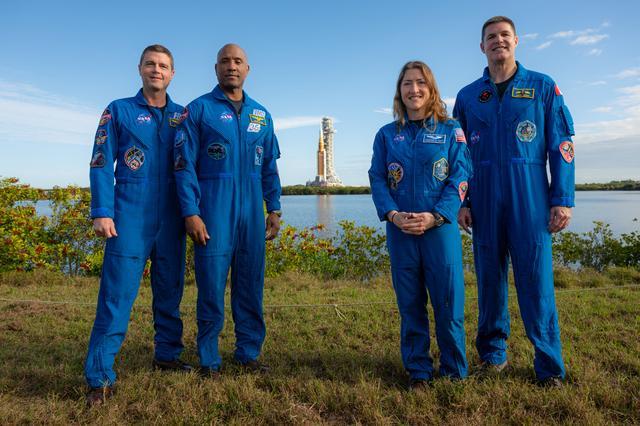
Part One of Four: On presence, perspective, and the planet we call home
Three weeks ago, four astronauts climbed into a spacecraft named Integrity and left Earth behind.
The Artemis II mission was the first crewed flight beyond low Earth orbit since Apollo 17 in 1972 — the first time in over fifty years that human beings have traveled to the vicinity of the Moon and back. NASA astronauts Reid Wiseman, Victor Glover, and Christina Koch, along with Canadian Space Agency astronaut Jeremy Hansen (pictured in cover photo, from left to right), traveled approximately ten days around the Moon, and splashed down in the Pacific Ocean on April 10th (NASA).
They've been home for eleven days now. And we've been thinking about what they saw.
That's the kind of thing worth sitting with.
A profound state of awe
There's a phenomenon that happens to nearly every astronaut who looks back at Earth from deep space. Researchers call it the “overview effect”: A sudden, involuntary awareness that our planet is small, borderless, and astonishingly alive (NASA). No map lines. No divisions. Just a marble of blue and green, luminous and suspended in space.
Pilot Victor Glover experienced it on April 6th, looking out the window of the Orion spacecraft: "I can really see Earth as one thing," he said. "In all of this emptiness [of the universe] you have this oasis, this beautiful place that we get to exist [in] together" (NASA).
From 250,000 miles (400,000 kilometers) away, that's what Earth looks like. What does it look like from where you're standing right now?
Coming back to where you are
We spend so much of our lives somewhere other than where we are. Mentally rehearsing tomorrow, replaying yesterday, scrolling through other people's moments while our own passes quietly by. We can get so wrapped in the small details that we forget the larger perspective — the gift of being alive. Of existing here, together, on the only home we have ever known.
The practice of mindfulness is, at its simplest, the practice of coming back. Back to this moment. This life.
The good news is that we don't need a rocket to find our way back. The invitation is always there — in any ordinary day, in any ordinary place.
What the astronauts found at 250,000 miles (400,000 kilometers), looking back at everything they had ever known compressed into a single glowing point, we can find here. Not the same view, but the same quality of seeing. The same sudden, humbling recognition that this place is extraordinary, and that we are extraordinarily lucky to be in it.
Awe lives here too. It always has. We just forget to notice.
Tomorrow is Earth Day, an invitation to look at the planet the Artemis crew looked back at. To step outside, feel the ground underfoot, notice the sky, and register, really register what a remarkable place this is.
Not as a concept. As an experience.
An invitation written in sky
At its farthest point, the Orion spacecraft reached 252,756 miles (406,771 kilometers) from Earth, a new record for human spaceflight. From that distance, you could hold up your thumb and blot out everything — every person you've ever loved, every forest, every ocean, every ordinary Tuesday morning with a cup of tea and nowhere urgent to be.
Carl Sagan understood the overview effect long before Artemis II. When Voyager 1 turned its camera back toward Earth from 4 billion miles (6.4 billion kilometers) away in 1990, he wrote: "That's here. That's home. That's us. On it everyone you love, everyone you know, everyone you ever heard of, every human being who ever was, lived out their lives." He famously called Earth a pale blue dot, “a mote of dust suspended in a sunbeam”. (Planetary Society; click here to see the “pale blue dot”).
252,756 miles is not 4 billion. But it was far enough for Victor Glover to see Earth as one thing. Far enough to call it an oasis. And it doesn't take a journey to the Moon to feel what both men were pointing at.
Earth Day is an annual invitation to feel even a fraction of that perspective — to stop, look around, and actually take in the place we inhabit. You don't need a spacecraft. You need a few minutes, and a willingness to pay attention.
Go outside. Look up. Let yourself be moved by what's there.
The Sun is 8.3 light minutes away — meaning the light you’re seeing right now has been traveling since before you started reading this. The nearest star beyond our Sun is 4.25 light years away (for perspective that’s 2,233,800 light minutes). And here we are, on this particular rock, in this thin shell of air, alive.
That's worth paying attention to.
This is the first in a four-part Earth Day Week series inspired by the Artemis II mission, exploring presence, perspective, letting go, and finding our way together. Part two: This Extraordinary Place arrives Tuesday.
The Mindfulness and Health Institute offers free live meditations every week that follow the Mindful Monday theme. See this week's theme.

0 comments
Leave a comment
Please log in or register to post a comment