
They Lost Signal Behind the Moon. Here's What That Teaches Us.
Part Three of Four: On resistance, silence, and the courage to let go
On April 6th, four astronauts went behind the Moon and disappeared.
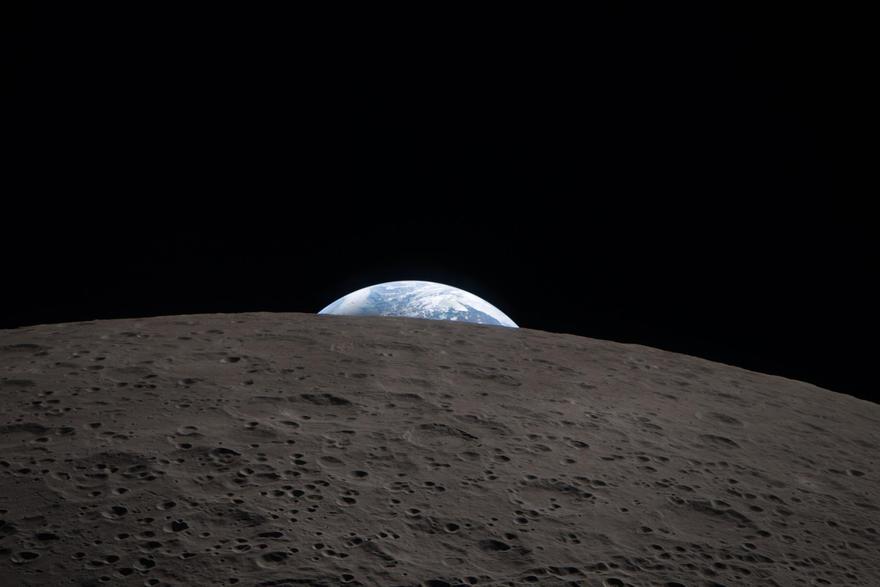
Not metaphorically. The Orion spacecraft passed into the Moon's shadow and all communication with mission control cut out completely (NASA). No signal. No voice. No way to reach them, check on them, or know what’s going on. For about forty minutes, the people who had spent years getting this crew safely into space could do nothing but wait. Click here to see photos of the lunar flyby (which is also our cover photo).
And here is the thing worth noting:
Worrying about whether the signal would return wouldn't have made the signal return (or even made it more likely to return). The crew would come back around, or they wouldn't. The trajectory held, or it didn't. In that silence, resistance wasn't just useless — it was beside the point entirely. The only thing left was to trust the work already done and allow the moment to unfold as it inevitably would.
Uncertainty behind the Moon
Most of us will never know what it’s like to orbit the Moon. But we likely do know that familiar feeling of uncertainty.
The moment the outcome leaves your hands. The diagnosis you're waiting on. The relationship that will find its way, or won't. The child you've done everything you can for and now have to watch walk out into the world. The email you've sent, the words you've said, the door you've closed or opened… and now there is nothing to do but sit with the not-yet-knowing.
We are not good at this. Most of us respond to uncertainty by gripping harder: replaying, rehearsing, catastrophizing, controlling whatever small thing remains controllable just to feel like we're doing something. The mind in resistance is very busy. And the trajectory doesn't care.
This is the quiet center of mindfulness practice. Not relaxation. Not the absence of feeling. But the radical act of meeting what is actually happening — uncertainty and all — without fighting it. Feeling the fear without becoming the fear. Letting the spacecraft orbit.
It takes more courage than it sounds.
The grip that changes nothing
The crew and hundreds of people had worked together toward this moment for years. Simulation, failure, adjustment, learning. Everything that could be done before that moment of silence, they had done. And then the moment came, and the work was over, and the only thing left was to patiently wait.
That's the whole practice, really. Preparation, and then release. We do what we can do. We show up, we practice, we try, we adjust. And then we arrive at the edge of what is ours to control.
We can resist. The mind says: But if I worry hard enough, something will change. If I stay tense and vigilant, I'll be ready. If I don't let myself hope, I won't be blindsided. These are ways the mind tries to stay in control of what was never ours to control.
The only thing resistance changes is how badly it hurts.
Being alive and knowing it
When Orion emerged from behind the Moon and the signal came back, Victor Glover's voice returned from the silence. Looking out the window at something so vast and strange that the only response was wonder.
He wasn't braced. He was simply present
Presence. That's what's waiting on the other side of resistance. Not the guaranteed good outcome — no one can promise that. But the ability to actually be where you are. To see what's in front of you instead of the disaster you were rehearsing. To notice that you are still here, that the world is still extraordinary.
The crew splashed down in the Pacific Ocean on April 10th, completing a journey of nearly 700,000 miles (1,118,494 km) — the same as flying from New York to London and back, over a hundred times.
And we are here, on the planet they flew away from and back to.
This week is Earth Day week. And the invitation is the same one that silence behind the Moon offered: to stop gripping, look up, and actually see where you are. Notice the particular blue of today's sky. Sense the wind against your skin. Become aware of the simple, astonishing fact of being here, right now, alive.
You don't have to travel 250,000 miles (400,000 km) into space to feel the preciousness of this place. You just have to pause long enough to notice.
Do what you can do.
Then look out the window.
This is the third in a four-part Earth Day Week series inspired by the Artemis II mission, exploring presence, perspective, letting go, and finding our way together. Part one: To the Moon and Back: They Traveled 250,000 Miles to See What's Right in Front of You. Part two: This Extraordinary Place: What You May Have Never Known About the Planet You Live On. Part four: Better Together: The Collective Wisdom of Community, arrives Friday.
The Mindfulness and Health Institute offers free live meditations every week that follow the Mindful Monday theme. See this week's theme.

1 comment
Thank you! Much needed wisdom.
Leave a comment
Please log in or register to post a comment