
Collective Wisdom: Standing on the Shoulders of Giants
Part Four of Four: On community, practice, and what becomes possible together
Four people went to the Moon.
Reid Wiseman, Victor Glover, Christina Koch, and Jeremy Hansen traveled ten days around the Moon and back (NASA). Four people in a capsule the size of a large SUV, farther from Earth than any human in history.
But they were never alone.
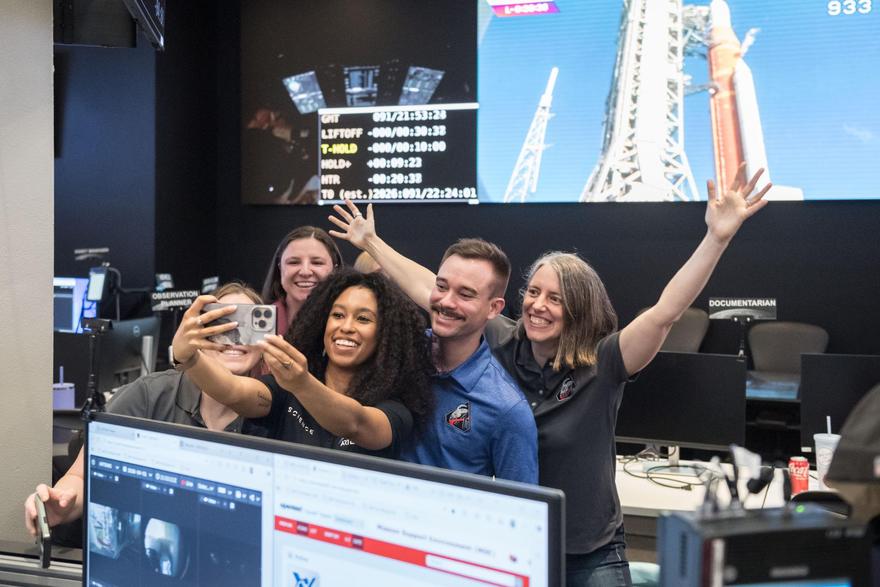
Thousands made sure they came back. Behind them stood flight directors, engineers, doctors, navigators, scientists, and countless others—each holding a different piece of the mission.
And even that is only part of the story.
As Sir Isaac Newton wrote in 1675, “If I have seen further than others, it is by standing upon the shoulders of giants.”
Behind the astronauts were centuries of scientific observation and inquiry, from early astronomers mapping the night sky to modern space program missions built on failed attempts, partial successes, and slow accumulation of knowledge.
By the time something becomes visible, it has often already been in motion for a very long time.
When the Orion capsule finally splashed down, the celebration wasn’t just for four people. It was for everything that had been building long before that moment arrived.
That is what makes the impossible possible. Not a few extraordinary people, but a community of different perspectives, built over time, and held together by a shared purpose no single person could complete alone.
We are all standing on the shoulders of giants
Mindfulness is, on the surface, a solitary practice.
You close your eyes. You follow the breath or another sensation in the body. You notice what arises and let it pass. No one can do it for you, and no one can see inside the moment you're having. In that sense it is the most private thing imaginable — an expedition into your own interior — conducted alone.
And yet.
We are all standing on the shoulders of giants.
The instructions we follow, the way we bring attention back, even the simple act of noticing, did not begin with us. These practices have been shaped, refined, and passed along by countless people who practiced before us.
And they are still being shaped now.
Each time we sit down to practice, we are stepping into something already in motion. We are not starting from the beginning. We are entering a practice that has been carried forward through time by teachers, practitioners, and traditions refining how to meet the moment as it is.
And at some point, this stops being abstract.
It becomes visible in the room.
Ask someone who has ever sat in a room or on Zoom with others and meditated, who has ever been guided through a difficult moment by a teacher's gentle guidance, who has ever shared what came up in practice and heard someone else say yes, me too — and they will likely tell you that something shifts. The practice deepens. The hard moments become more bearable. What felt private becomes something shared.
We are social creatures practicing something deeply internal. And yet what we discover in practice is rarely just our own.
This is what participatory mindfulness points to: Not just practicing side by side, but learning from and supporting each other in real time. Hearing someone else name what you thought was uniquely yours. Realizing your restlessness, your doubt, your starting over again, are not departures from the practice, but expressions of it.
In shared practice, experience begins to normalize. What felt isolating becomes recognizable. What felt like failure becomes human pattern. And in being seen and seeing others, the practice often steadies, not because it becomes easier, but because it is no longer carried alone.
The astronaut trains alone in the simulator. But the mission is never carried alone. It is held by many, across distance, roles, and time.
And when the capsule returns, what comes home is not just four astronauts. It is the work of thousands, made visible at last.
That is what community does. It carries what no single person can hold alone.
How we go deeper, together
This week, we've been sitting with what Earth Day and the Artemis II mission has to offer us. Not as a space story, but as a human one.
A reminder to be present in the life we actually have. A reminder that the grip that changes nothing can be released. The world is a wonderfully beautiful place if we take a moment to notice. And this: that the most extraordinary things human beings have ever done, they have done together.
That togetherness is, at its heart, an act of hope. The mission required thousands of people to believe that exploring the cosmos was worth pursuing, despite all odds. A mindfulness community is quieter is scale but no less real — the simple belief that showing up, again and again, in practice and in life, simply matters.
Your mindfulness practice is yours. The breath is yours. The moment of stillness, the difficult sensation you learn to sit with, the gradual shift in how you meet your own life — all of it yours, earned in private.
But hope, like space travel, is better shared.
To everyone practicing with us in the MHI community, thank you. We are grateful to be learning alongside you, standing together on what has come before, and continuing to build what comes next.
This is the fourth in a four-part Earth Day Week series inspired by the Artemis II mission, exploring presence, perspective, letting go, and finding our way together. Part one: To the Moon and Back: They Traveled 250,000 Miles to See What's Right in Front of You. Part two: This Extraordinary Place: What You May Have Never Known About the Planet You Live On. Part three: They Lost Signal Behind the Moon - Here's What That Teaches Us.
The Mindfulness and Health Institute offers free live meditations every week that follow the Mindful Monday theme. See this week's theme.
And if you're ready to explore further, our full range of evidence-based courses are waiting, ready whenever you are.

0 comments
Leave a comment
Please log in or register to post a comment